

Explore the full range of titles - discover sports stars, scientists, artists and much more...
Explore the full range of titles
ShopArticles
Nelson Mandela: Biography and Facts for Kids
Posted on September 30, 2026
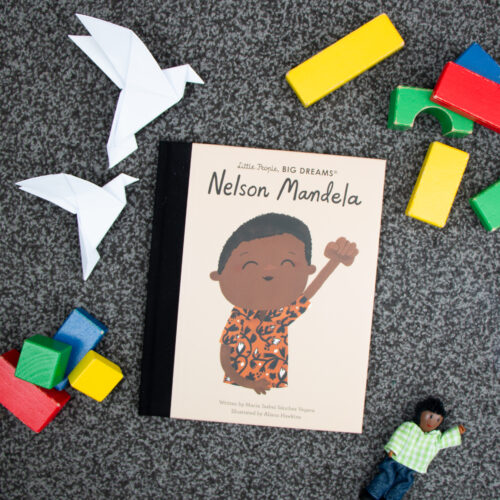
Nelson Mandela changed the lives of millions of South African people through his work and remarkable life, most notably leading the peaceful end to Apartheid in South Africa. He also became the country’s first Black president.
Born in 1918 in Mvezo, South Africa, Mandela was the son of Chief Henry Mandela of the Madiba clan. After his father’s death, Nelson renounced his claim to the chieftainship to become a lawyer. In 1944, he joined Black-liberation group the African National Congress (ANC), becoming a leader of its Youth League.
With fellow ANC leader Oliver Tambo, Mandela established South Africa’s first Black law practice in 1952 and began a career of defiance and opposition to the country’s discriminatory laws. Mandela’s original stance of nonviolent protest changed in 1960 following the massacre of unarmed Black South Africans at Sharpeville.
He was eventually tried for sabotage, treason and violent conspiracy, and sentenced to life imprisonment in 1964. After decades in jail, and following South Africa’s deteriorating political situation in the 1980s, Mandela was finally released in 1990. He became president of the ANC, leading negotiations with President de Klerk to end Apartheid and bring about a peaceful transition to non-racial democracy in South Africa.
Following the country’s first elections by universal suffrage in 1994, Mandela was sworn in as president of the country’s first multiethnic government.
Nelson Mandela: At a Glance
Name: Nelson Rolihlahla Mandela
Also known as: Madiba Mandela (his Thembu clan name, which is traditionally used out of respect and affection)
Born: 18th July 1918 in Mvezo, South Africa
Nationality: South African
Died: 5th December 2013
Best known for: Becoming the first Black president of South Africa and a civil rights hero. Mandela won the Nobel Prize for Peace in 1993, along with South Africa’s president at the time, F.W. de Klerk, for having led the transition from apartheid to a multiracial democracy.
How Nelson Mandela Followed His Dream
Nelson Mandela’s ultimate dream was a united, non-racial society which afforded all its citizens their human dignity.
During his 1964 trial, following which he narrowly avoided the death penalty, he gave a speech, saying, “I have cherished the ideal of a democratic and free society in which all persons live together in harmony and with equal opportunities… It is an ideal which I hope to live for and to achieve. But if needs be, it is an ideal for which I am prepared to die.”
Mandela envisioned a South Africa where no group dominated the other, securing basic human rights for all. He helped to create a more peaceful Africa through cooperation and mutual respect.
Mandela was fighting against Apartheid, but he was also fighting for something: a better world, with freedom, justice and dignity for all. During the long years of his imprisonment, Mandela twice refused offers of conditional release because he believed his freedom was intrinsically tied to the freedom of all South Africans.
Ten Facts About Nelson Mandela for Kids
1. His real name is Rolihlahla. Mandela’s given Xhosa name means ‘to pull a branch off a tree,’ which colloquially translates to ‘troublemaker’. The name ‘Nelson’ was given to him by his teacher on his first day of elementary school. Giving children English names was a widespread practice in South Africa during the 1920s and was often seen by the colonial system as a sign of being ‘civilized’.
2. Nelson Mandela’s many honours include more than 695 awards, including the prestigious Nobel Peace Prize in 1993. More than 25 schools, universities and educational institutions have been named after Nelson Mandela. He was awarded 115 honorary degrees and more than 95 sculptures, statues, or pieces of art have been dedicated to him.
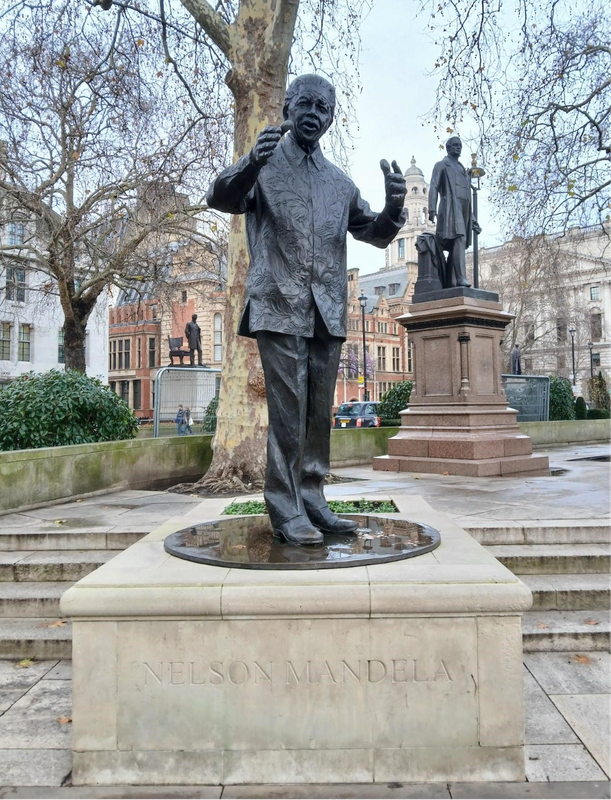
Nelson Mandela’s statue in London’s Parliament Square by artist Ian Walters
3. A keen boxer, Mandela trained seriously as an amateur heavyweight and sparred with professional fighters including Jerry Moloi, a contender for South African lightweight champion. He noted in his autobiography that he liked the sport because it stripped away social status, age and race.
4. Nelson Mandela International Day takes place every year on his birthday, July 18th. Established by the United Nations in 2009 to honour Mandela’s life and legacy, people are encouraged to spend 67 minutes doing community service or helping others, to represent the 67 years Mandela fought for social justice and human rights.
5. Mandela believed, “Children are our greatest treasure”. On receiving the Nobel Peace Prize, he gave part of the prize money to help street children, and as president he donated half his salary. Spending time with children and young people gave Mandela energy: “Whenever I’m with vibrant young people, I feel like a recharged battery.”
6. The Nelson Mandela Foundation launched the Nelson Mandela Legacy Sporting Series in 2026. Encouraging both individuals and communities to play an active role in creating positive social change, it’s a unified platform bringing together major sporting initiatives aimed at driving social impact, promoting active citizenship and honouring Mandela’s enduring legacy.
7. Nelson Mandela spent twenty-seven years in prison, initially on Robben Island and later in Pollsmoor Prison and Victor Verster Prison. Amid growing domestic and international pressure, and with fears of a racial civil war, president F.W. de Klerk released him in 1990.
8. Mandela began writing his autobiography, The Long Walk to Freedom, in secret while imprisoned on Robben Island in the 1970s. The smuggled manuscript served as the basis for the final published memoir. The title reflects his lifelong journey and belief that freedom is a continuous, unbroken path. As he wrote, “I have discovered the secret that after climbing a great hill, one only finds that there are many more hills to climb.” There is also an abridged edition for younger children.
9. Mandela refused offers of conditional release from the Apartheid government in 1985 and 1988, insisting that only free men could enter into political negotiations. “I cannot sell my birthright nor am I prepared to sell the birthright of the people to be free,” Mandela declared in a message from his prison cell in Cape Town in 1985.
10. He established the Truth and Reconciliation Commission in 1995 to expose human rights violations committed during the Apartheid era. When he left public office, Mandela established the Nelson Mandela Foundation to champion rural development, education and HIV/AIDS awareness.
What Can Children Learn From Nelson Mandela?
“A winner is a dreamer who never gives up”
Nelson Mandela had almost boundless resilience and determination, and this powerful quote reminds us that success isn’t always about instant victories or natural talent, but about persistence and belief.
Whether you’re a student facing academic pressure, a professional navigating career challenges, an entrepreneur dealing with failure, or just striving for personal growth, Mandela reminds us that dreaming alone is not enough – turning those dreams into reality requires persistence, resilience and patience.
Mandela began his fight for a united South Africa in 1952 and finally saw his dream of a united country with a multiethnic government realised in 1994.
Forgiveness and humanity
Nelson Mandela chose to forgive his captors, even after spending 27 years in prison, to prevent a racial civil war and unite South Africa. As he famously noted upon his release in 1990: “As I walked out the door toward the gate that would lead to my freedom, I knew if I didn’t leave my bitterness and hatred behind, I’d still be in prison.” He often stated that, “resentment is like drinking poison and then hoping it will kill your enemies.”
He invited his former prison guards and Apartheid-era leaders to his 1994 presidential inauguration, and sought out and shared a meal with the former warden of Robben Island, easing the captor’s fear of reprisal and demonstrating his belief that reconciliation builds nations.
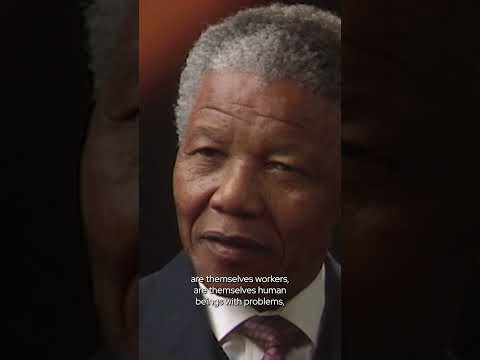
Mandela on his sympathy for his prison wardens during his 27-year incarceration
One team, one country
A global icon in the fight for human rights, Nelson Mandela is still regarded as one of modern history’s most inspiring and transformative leaders.
One of the most interesting aspects of his leadership was his ability to look beyond politics as a means of uniting people, not only in his own country, but around the world. For example. he identified sport as a vital way to bring people together.
The film Invictus, starring Morgan Freeman as Mandela, celebrates this. It depicts Mandela persuading the ANC to support rugby as a gesture of reconciliation towards white Afrikaners. In the tense and deeply divided aftermath of apartheid, his vision of uniting Black and white South Africans behind their national rugby team, the Springboks, seemed almost impossible. Yet Mandela was determined to turn that vision into reality.
When Mandela walked out on to the pitch before the 1995 World Cup final hosted by South Africa in the green Springbok jersey, the mostly white Afrikaner crowd was won over, and spontaneously began to cheer, “Nelson! Nelson! Nelson!”
Mandela recognised that sport can break down barriers in a unique way and speaks to people of all backgrounds. On the field, everyone plays by the same rules, while the shared joy of winning – or the sadness of losing – creates an instant emotional bond between strangers.
Mandela’s inspiring speech at the inaugural Laureus World Sports Awards in 2000
Read More About Nelson Mandela
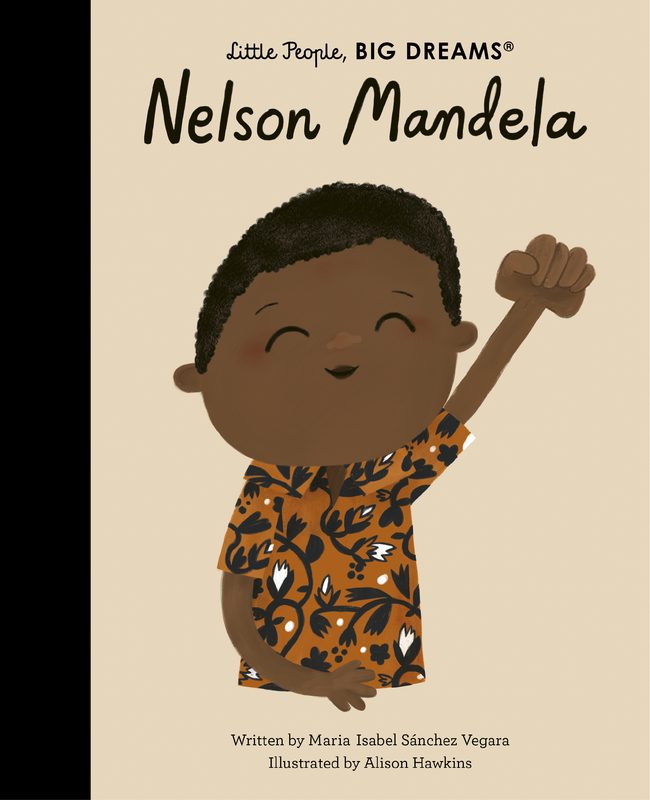
For inspiration about Nelson Mandela’s childhood, as well as his career, read Little People BIG DREAMS Nelson Mandela.
Mandela’s emotive, compelling and uplifting autobiography, Long Walk to Freedom, tells the full story of his epic life, and inspired a film starring Idris Elba.
RELATED PRODUCTS

Nelson Mandela
Illustrated by Alison Hawkins
Meet Nelson Mandela, South Africa’s first Black president, and his fight for equality. Little Nelson’s given name was Rolihlahla, which …

Kamala Harris
Illustrated by Lauren Semmer
Meet Kamala Harris, the first woman, first Black person, and first South Asian American to be elected Vice President of the …

Michelle Obama
Illustrated by Mia Saine
Meet Michelle Obama, the iconic first lady, advocate, lawyer, and author. Young Michelle grew up on the South Side of …

Harriet Tubman
Illustrated by Pili Aguado
Meet Harriet Tubman, the Underground Railroad conductor who "never lost a single passenger." Little Harriet was born into slavery on …

Rosa Parks
Illustrated by Marta Antelo
Meet Rosa Parks, the "Mother of the Freedom Movement." Rosa Parks grew up in Alabama, where she learned to stand …

Martin Luther King Jr.
Illustrated by Mai Ly Degnan
Meet Martin Luther King Jr., the inspiring minister and civil rights activist. Little Martin grew up in a family of …
Quarto Kids on social media (for grown-ups)